


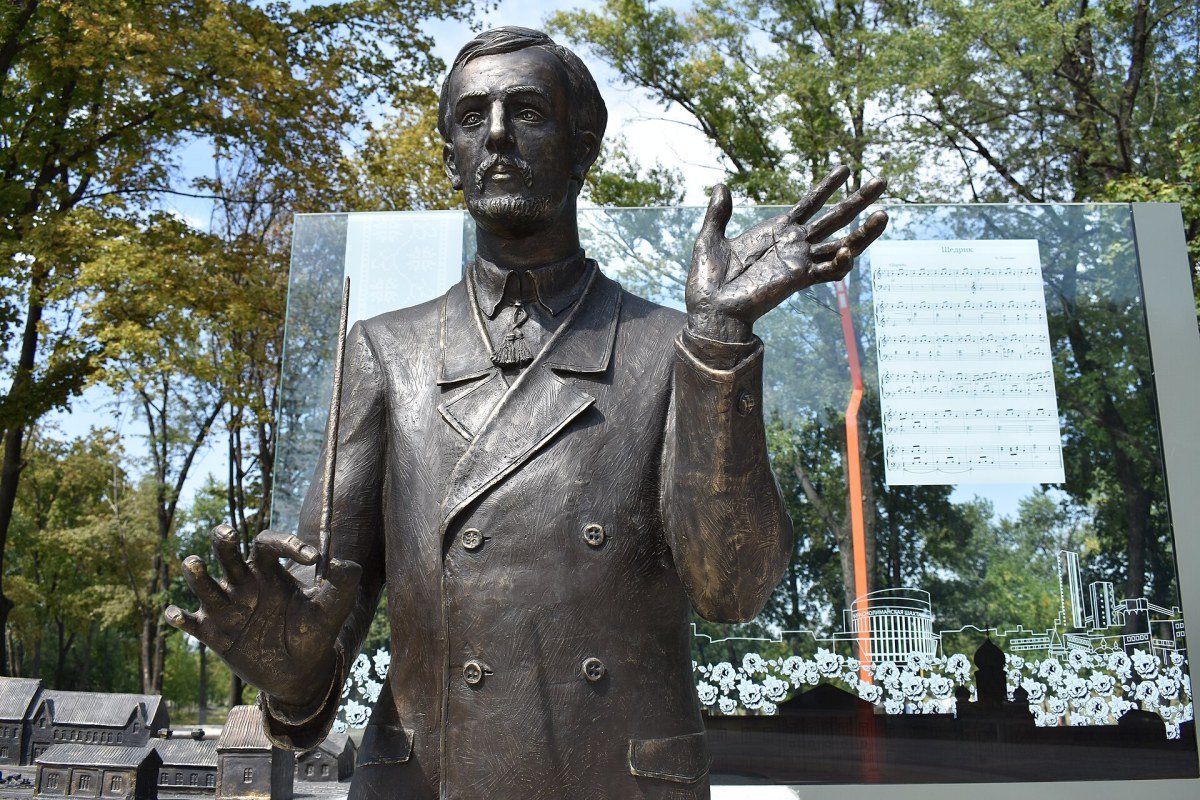
Every winter, a short, spinning four-note phrase fills concert halls, television adverts and film soundtracks around the world. Most listeners know it as "Carol of the Bells". Far fewer know that the melody comes from Ukraine, that its original words have nothing to do with bells or Christmas, and that it reached the world thanks to a Ukrainian choir sent abroad as a kind of musical embassy a century ago. The story of Shchedryk is a story of folk tradition, a gifted composer and cultural diplomacy.
A Swallow at the Window
Shchedryk belongs to a genre of Ukrainian ritual songs called shchedrivky, sung on the evening before the New Year to wish a household prosperity. The word comes from "shchedryi", meaning generous. In the song, a swallow flies into the yard and calls the master of the house to come out and see his wealth: his sheep have given birth to lambs, he will have plenty of money, and he has a beautiful wife.
The swallow is an interesting detail. Swallows return in spring, not winter, and scholars believe the song preserves a memory of an ancient calendar in which the year began in spring. When the church calendar moved the New Year to January, the songs moved with it, but the imagery of returning birds and newborn lambs stayed.
Mykola Leontovych's Masterpiece
The composer who turned the folk tune into a choral miniature was Mykola Leontovych, a teacher and choirmaster from the Podillia region. He worked on arrangements of the song for years, refining it through several versions. The best-known version was performed in December 1916 by the choir of Kyiv University and quickly became popular.
Leontovych's arrangement is remarkable for its economy. The famous four-note ostinato repeats almost throughout the piece, while other voices enter with the melody, creating a sense of constant, glittering motion. This simple but hypnotic structure is the reason the piece is so easy to recognise and so easy to adapt.
Leontovych's life ended tragically. In January 1921 he was shot dead at his father's home by an agent of the Soviet security services, a killing that has long been seen as part of the wider repression of Ukrainian cultural figures. Today musicians and music historians honour him as one of the founders of modern Ukrainian choral music, and many schools, streets and choirs bear his name.
The Choir That Toured the World
After the collapse of the Russian Empire, the short-lived Ukrainian People's Republic decided to show the world that Ukraine had its own culture and identity. In 1919 its government sent a choir, led by the conductor Oleksandr Koshyts, on a long international tour. The Ukrainian Republic Capella, later known as the Ukrainian National Chorus, performed across Europe and then in the Americas.
The key steps of the tour that brought Shchedryk to a global audience can be summarised as follows:
- 1919: the choir begins touring European capitals, including Prague, Vienna, Paris, London and Berlin, with Shchedryk in its programme.
- 1922: the chorus arrives in North America and performs at Carnegie Hall in New York in October, where the song is received with enthusiasm.
- The following years: the choir tours extensively across the United States, and the melody spreads among American choral directors.
- 1936: Peter J. Wilhousky, an American composer and arranger of Ukrainian descent, publishes new English words, creating "Carol of the Bells".
How the Swallow Became Bells
Wilhousky's text did not translate the Ukrainian original. Instead, he wrote new lyrics inspired by the sound of the music, which reminded him of ringing hand bells. His words, which describe bells chiming out the joy of Christmas, fitted the melody so well that the English version soon became a staple of American Christmas concerts. Because of the new words, the song gradually moved from New Year to Christmas.
From there, it entered popular culture. The melody has appeared in films, cartoons, television series, rock and metal versions, jazz improvisations and electronic remixes. Many listeners who hum it every December have no idea that it was once a Ukrainian village song about a swallow.
A Symbol of Ukrainian Culture
In recent years, Shchedryk has become an important cultural symbol for Ukrainians. Musicians and diaspora communities perform the original Ukrainian version alongside the English one, and many concerts now explain its origins to audiences. For Ukrainians, the song's journey represents something larger: proof that their culture, often overshadowed by more powerful neighbours, has long been part of the world's shared heritage.
So the next time you hear those four repeating notes, remember the swallow flying into a Ukrainian farmyard, the village singers wishing their neighbours a generous year and the choir that carried that wish across the ocean.
What's Your Reaction?
 Like
0
 Dislike
0
 Love
0
 Funny
0
 Wow
0
 Sad
0
 Angry
0











Comments (0)