


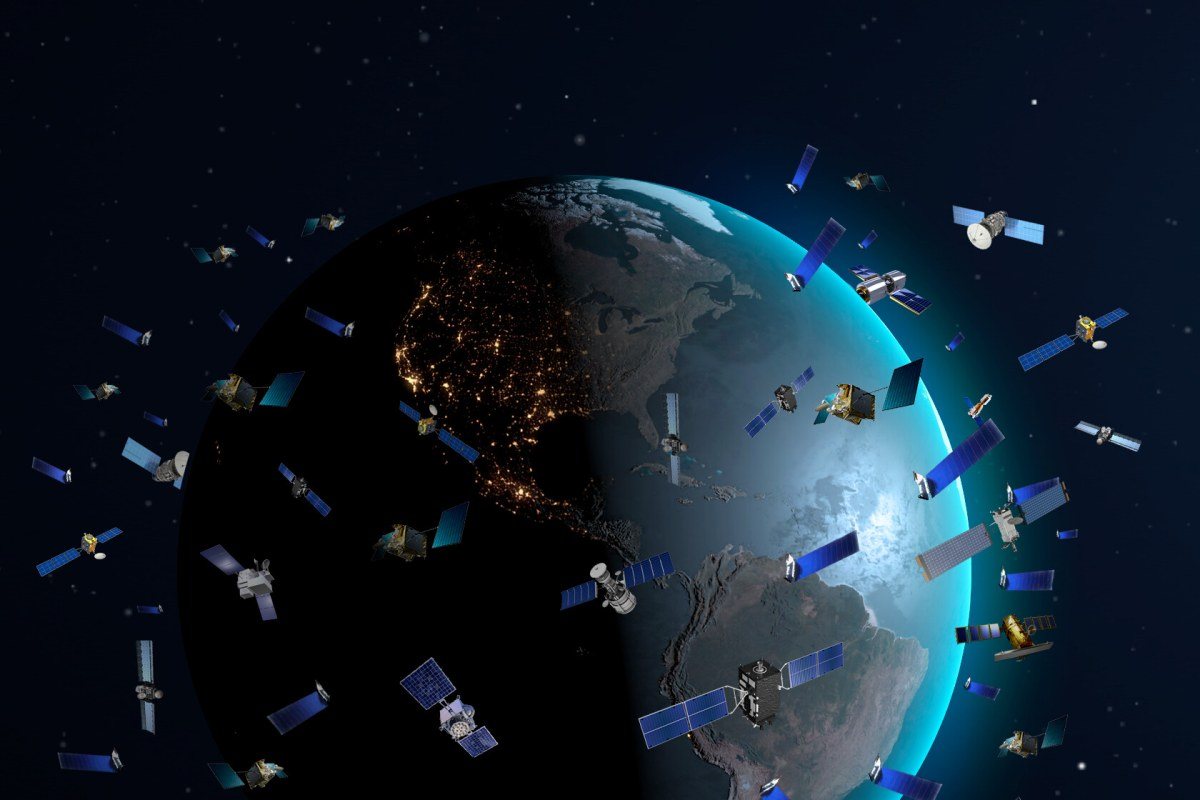
For decades, satellite internet had a reputation as the option of last resort: expensive, slow and plagued by long delays. That reputation came from the physics of where the satellites were placed – very far from Earth. A newer approach places large numbers of smaller satellites in much lower orbits, creating constellations that can deliver broadband to ships, aircraft, rural homes and disaster zones. This article explains the concept of low Earth orbit (LEO) satellite internet, how it differs from traditional systems and what trade-offs it involves.
Geostationary versus low Earth orbit
Traditional communications satellites sit in geostationary orbit, about 35,786 kilometres above the equator. At this height, a satellite completes one orbit in exactly the time it takes Earth to rotate, so it appears fixed in the sky. That makes it convenient: a dish on the ground can point at one spot forever, and just three satellites can cover most of the planet.
The drawback is distance. A signal must travel from the user up to the satellite, down to a ground station, and then the reply makes the same journey back. Even at the speed of light, this round trip takes over half a second. That delay, or latency, makes video calls awkward and online gaming nearly impossible.
Low Earth orbit generally refers to altitudes below about 2,000 kilometres, and many internet constellations operate between roughly 500 and 1,200 kilometres. Because the satellites are dozens of times closer, latency drops dramatically and becomes comparable to many ground-based connections.
Why you need thousands of satellites
Low orbit brings a new challenge. A satellite at these altitudes circles the Earth in roughly an hour and a half, racing across the sky and staying visible from any given point for only a few minutes. To provide continuous service, operators need so many satellites that, at any moment, at least one is overhead for every customer. This is why LEO internet systems are built as constellations of hundreds or thousands of spacecraft arranged in carefully planned orbital "shells".
Building such constellations became practical thanks to several developments: mass production of small satellites, cheaper rocket launches (including reusable boosters) and advances in electronics that pack powerful radios into compact spacecraft.
How the connection works
A LEO internet system has three main parts:
- The user terminal – a flat antenna, often called a phased-array antenna, that steers its beam electronically rather than physically moving. This lets it track fast-moving satellites and switch smoothly from one to the next.
- The satellites – which receive the user's signal and relay it either down to a ground station or, in more advanced designs, to other satellites using laser links.
- Ground stations – also called gateways, which connect the satellite network to the terrestrial internet through fibre-optic cables.
Inter-satellite laser links are especially significant. They allow data to hop between satellites in space, so a user in the middle of an ocean can be connected even when no ground station is within reach. In the vacuum of space, light travels faster than it does inside glass fibre, which in theory can make some long-distance routes quicker than undersea cables.
Strengths of the LEO approach
- Coverage of remote areas – mountains, islands, deserts and sparsely populated farmland that are expensive to reach with cables.
- Mobility – service for ships, aircraft, trains and vehicles on the move.
- Rapid deployment – terminals can be set up quickly after natural disasters or when ground infrastructure is damaged.
- Low latency – suitable for video calls and interactive applications that geostationary systems struggle with.
The challenges and concerns
The concept also raises real questions. Each satellite can only serve a limited amount of bandwidth within its coverage area, so performance can drop when many users in one region share the same satellites. Terminals need a clear view of the sky, and heavy rain or snow can weaken signals at the higher frequencies used.
Wider concerns involve space itself. Thousands of additional satellites increase the risk of collisions and orbital debris, which is why operators design satellites to deorbit at the end of their lives and to manoeuvre away from hazards. Low orbits help here, because atmospheric drag eventually pulls dead satellites down to burn up. Astronomers have also raised concerns about satellites appearing as bright streaks in telescope images, prompting efforts to make spacecraft less reflective.
Finally, the radio spectrum and orbital slots are shared global resources, regulated through national authorities and the International Telecommunication Union. Coordinating many competing constellations is a growing diplomatic and technical task.
A complement, not a replacement
LEO satellite internet is unlikely to replace fibre in dense cities, where cables offer far more capacity at lower cost per user. Its real value lies in filling the gaps: connecting places that cables do not reach, providing backup when ground networks fail and keeping people online while they travel. As constellations grow and technology matures, satellite broadband is shifting from a last resort to a genuine part of the world's connectivity mix.
What's Your Reaction?
 Like
0
 Dislike
0
 Love
0
 Funny
0
 Wow
0
 Sad
0
 Angry
0










Comments (0)