


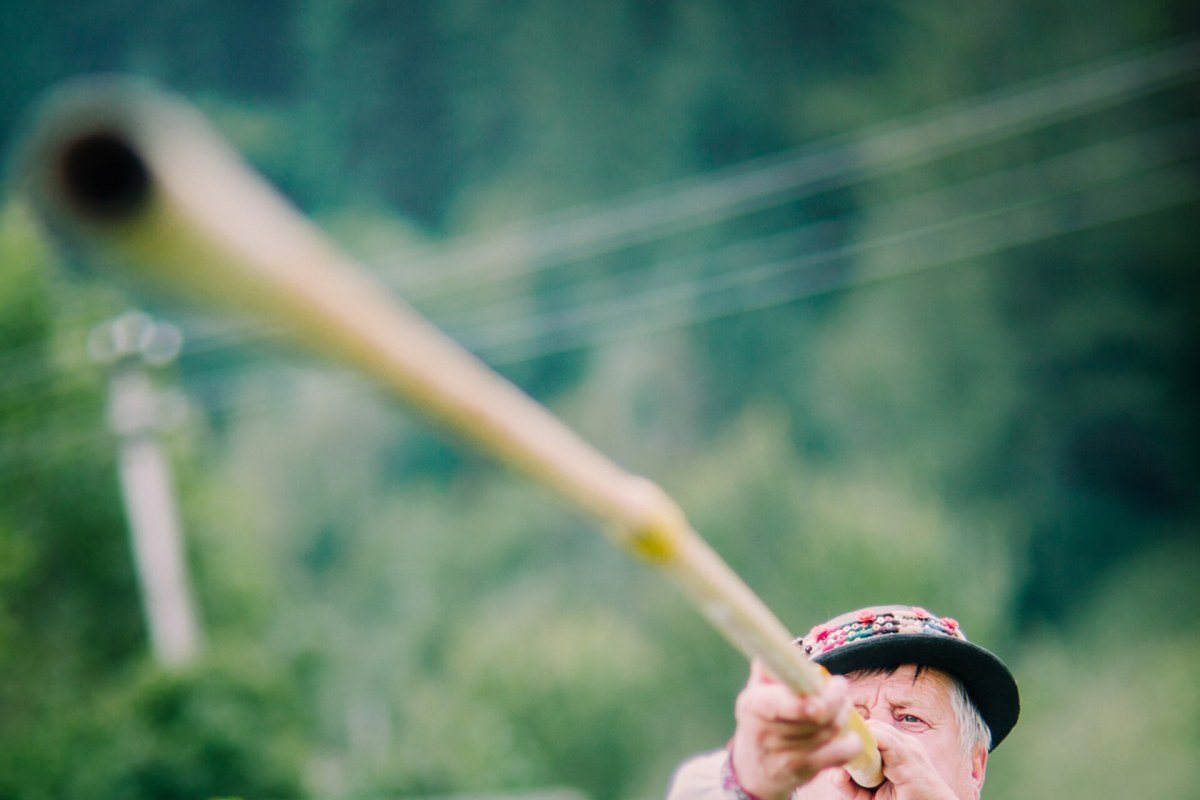
On a clear morning in the Ukrainian Carpathians, a long, mournful sound can roll across the valleys and echo from mountainside to mountainside. It comes from the trembita, a wooden horn so long that a musician has to raise it high into the air to play. For the Hutsuls, the highlanders of the eastern Carpathians, the trembita was not only a musical instrument but also a means of communication, a signal of joy and grief, and a symbol of mountain life itself.
An Instrument of the Hutsul Highlands
The trembita belongs to the family of long wooden trumpets found in several mountain cultures, including the Alpine horn of Switzerland and similar instruments in the Polish and Romanian Carpathians. In Ukraine it is most closely associated with the Hutsul region, which covers parts of the Ivano-Frankivsk, Chernivtsi and Zakarpattia regions.
Hutsul life centred on shepherding. Every summer, flocks of sheep were driven up to the high mountain pastures, the polonyny, where shepherds lived for months, far from their villages. In this world of distant homesteads and steep slopes, a loud, far-carrying signal was essential, and the trembita filled that need.
How a Trembita Is Made
Crafting a trembita is a specialised skill passed down in a few families of masters. Traditional instruments are usually between two and a half and three metres long, sometimes longer. The process, as described by craftsmen and ethnographers, follows several stages:
- Choosing the wood. Makers prefer spruce, ideally a tree that grew slowly in harsh conditions. Folk tradition holds that the best trembita comes from a spruce struck by lightning, which is believed to give it a special voice.
- Splitting and hollowing. The trunk is split lengthwise into two halves, and each half is carefully hollowed out to form a narrow, conical channel.
- Joining. The halves are glued back together and tightly wrapped in strips of birch bark, which seal the instrument and protect it from moisture.
- Mouthpiece. A small mouthpiece made of wood, horn or metal is inserted into the narrow end.
The trembita has no finger holes or valves. Like a natural bugle, it produces a series of natural harmonics, and the player changes the note by adjusting lip tension and breath. Mastering it requires strong lungs and considerable practice.
A Voice for News, Joy and Sorrow
Before telephones and radios, the trembita served as the mountain telegraph. Different melodies, or signals, conveyed specific messages that the whole valley could understand. Traditional uses included:
- Daily signals on the pastures: shepherds called each other, announced that the flock was being driven out or brought back, and signalled danger or a lost animal.
- Announcing a death: one of the trembita's most solemn roles was to inform the village that someone had died; it also accompanied funeral processions.
- Weddings and celebrations: festive tunes greeted guests and accompanied ceremonies.
- Christmas: in some villages, trembitas played during the Christmas period and accompanied carollers.
- Calls for gathering: the sound could call people together in emergencies or for communal work.
Because its sound can travel many kilometres in good conditions, the trembita created a sense of connection between scattered households. Hearing it, people knew that life in the mountains was going on.
Hearing the Trembita Today
With the decline of traditional shepherding, the trembita's practical role faded, but it has not disappeared. It remains a strong symbol of Hutsul identity, and it is still played at funerals, weddings and religious holidays in some mountain villages. Folk ensembles and festivals feature trembita players, and the instrument has found its way into contemporary Ukrainian music as well, where its archaic sound adds a powerful, atmospheric layer.
Visitors to the Carpathians have several chances to hear it:
- At folk festivals in towns such as Kosiv, Verkhovyna and Kolomyia, especially during the summer.
- At ethnographic museums and open-air museums, where musicians sometimes demonstrate the instrument.
- From craftsmen who make trembitas and other Hutsul instruments, some of whom welcome visitors to their workshops.
If you buy a small souvenir trembita, remember that full-sized instruments are serious works of craftsmanship that take weeks to make. And if you ever hear its deep call drifting across a Carpathian valley, take a moment to listen. It is one of the oldest sounds of Ukrainian mountain culture, still speaking across the hills.
What's Your Reaction?
 Like
0
 Dislike
0
 Love
0
 Funny
0
 Wow
0
 Sad
0
 Angry
0











Comments (0)