


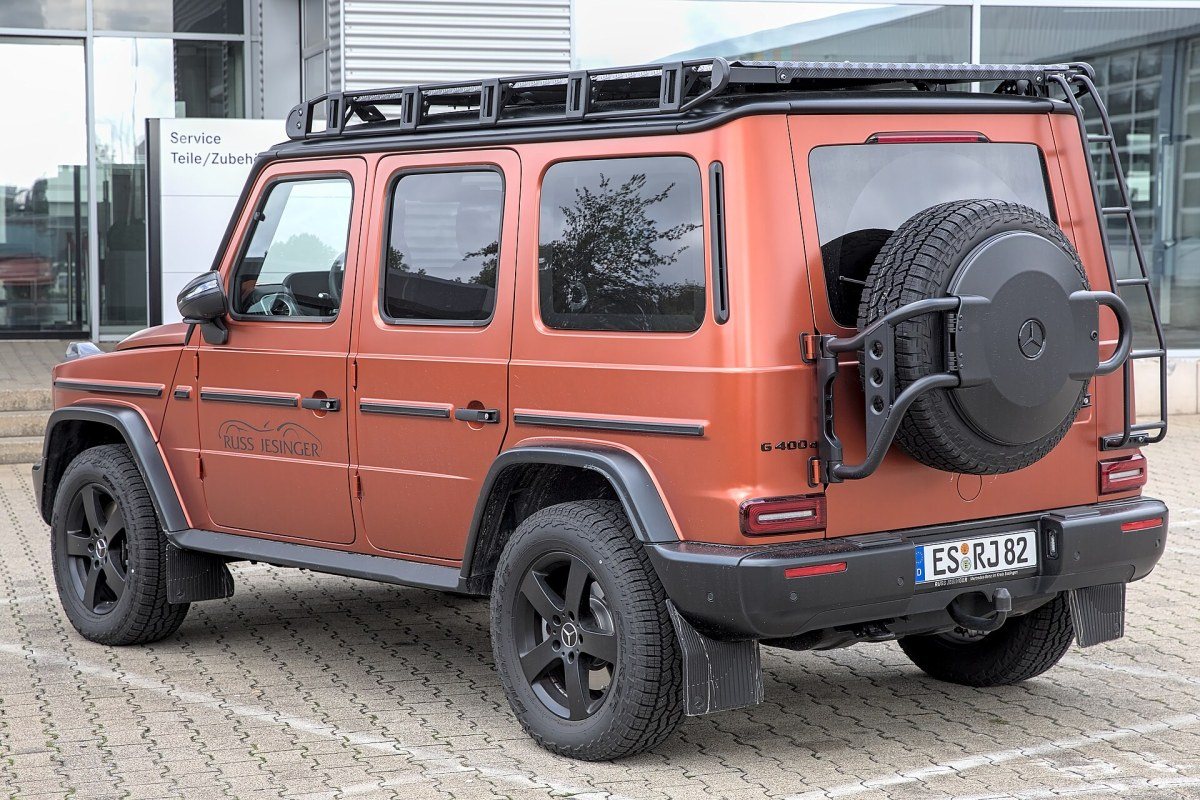
Few vehicles have changed their image as dramatically while changing their shape so little. The Mercedes-Benz G-Class, often simply called the G-Wagen, began life as a utilitarian off-roader intended for military, government and commercial use. Decades later it is a status symbol seen outside expensive hotels and boutiques, yet it still carries the same upright, boxy silhouette and much of the off-road hardware that made its reputation.
A German-Austrian Partnership
The G-Class was developed in the 1970s as a joint project between Daimler-Benz and the Austrian company Steyr-Daimler-Puch, which had long experience building all-terrain vehicles. Production was based in Graz, Austria, where the vehicle has been built ever since, today by the contract manufacturer Magna Steyr.
The name comes from the German word Geländewagen, meaning "cross-country vehicle". The model was launched in 1979, and in some markets it was sold under the Puch name rather than as a Mercedes-Benz. From the beginning it was offered with short and long wheelbases and a variety of body styles, including open, station wagon and van versions.
Built for the Hardest Jobs
The early G-Class was designed with function first. Its engineering reflected the needs of armies, border guards, forestry services and expeditions:
- a strong ladder-frame chassis with rigid axles front and rear;
- a low-range transfer case for steep and slippery terrain;
- three locking differentials, which became one of the model's signature features;
- flat body panels and simple glass that were easy to repair or replace;
- exterior door handles and hinges that look much as they did on the original.
Military versions were adopted by numerous armed forces around the world, and the G-Class gained a reputation as a durable vehicle that could survive tough service. It was also used on long-distance rallies and expeditions, proving its endurance in deserts and mountains.
The Shift Towards Luxury
From the 1990s onwards Mercedes-Benz increasingly positioned the civilian G-Class as a premium vehicle. In 1994 the model officially adopted the G-Class name in line with the company's new naming system. Interiors gained leather, wood and modern electronics, and more powerful engines arrived, including V8 and V12 options in high-performance versions developed by AMG.
This combination of genuine off-road ability, solid build and an unmistakable look appealed to wealthy buyers, celebrities and anyone wanting a vehicle with presence. The sound of its doors closing, a heavy mechanical clunk, became part of its appeal.
The Papal Connection
The G-Class also gained fame as a Popemobile. Specially modified versions with transparent rear enclosures were built to carry the Pope during public appearances, adding to the model's recognisability around the world.
Evolution Without Revolution
Unlike most cars, which are replaced with entirely new designs every few years, the G-Class evolved gradually. Mechanical components, safety systems and interiors were updated over time, but the basic shape remained. When Mercedes-Benz launched a thoroughly re-engineered G-Class in 2018, it deliberately kept the familiar profile, round headlights, exposed door hinges and spare wheel on the tailgate, even though almost every component underneath was new. The front suspension became independent to improve on-road comfort, while the low range and three differential locks were retained.
The decision to preserve the look was a calculated one. Owners and fans had made it clear that the G-Class's appeal lay in its authenticity, and a softer, more aerodynamic shape would have risked turning it into just another luxury SUV. Instead, engineers worked around the boxy form, improving refinement, safety and technology underneath while leaving the familiar outline largely untouched.
More recently Mercedes-Benz added an all-electric version, signalling that even this traditional off-roader is part of the industry's shift to electrification.
Why the G-Class Endures
Several factors explain why the G-Class has outlived many rivals and remained in production for so long:
- Authenticity. Its off-road ability is real, not just a styling exercise.
- Timeless design. The square shape is instantly recognisable and has become a brand in itself.
- Continuity. Gradual evolution kept loyal customers while attracting new ones.
- Versatility. The same basic vehicle served soldiers, explorers, families and luxury buyers.
The G-Class shows that a vehicle designed for practical purposes can become a design icon when it stays true to its original character. More than four decades after its debut, the boxy off-roader from Graz is still unmistakably itself.
What's Your Reaction?
 Like
0
 Dislike
0
 Love
0
 Funny
0
 Wow
0
 Sad
0
 Angry
0












Comments (0)