


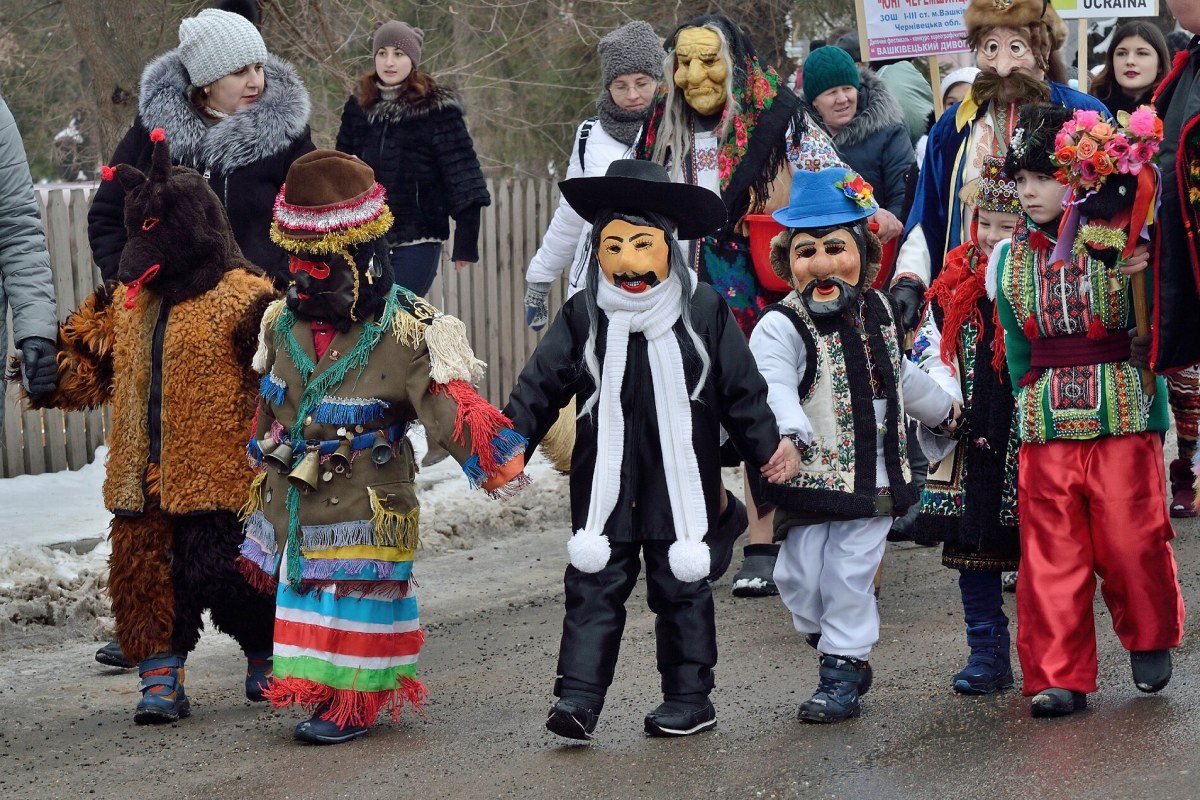
Imagine a winter night in a Bukovinian village. Snow crunches underfoot, brass bands play, and a procession of strange figures moves from house to house: a horned goat, a growling bear, devils, soldiers, an old man and woman, and at the centre a "bride" named Malanka, who is in fact a young man in a skirt and headscarf. This is Malanka, the boisterous folk carnival that marks the Ukrainian New Year's Eve and one of the most theatrical winter traditions in Eastern Europe.
Saint Melania and Saint Basil
The festival takes its name from St Melania the Younger, a fifth-century Roman ascetic whose feast falls on the last day of the year in the Eastern church calendar. The next day honours St Basil the Great, known in Ukrainian as Vasyl. Over centuries the two saints merged with much older seasonal rites, and folk culture turned them into a pair of characters: the lively Malanka and her companion Vasyl.
Under the Julian calendar, the evening of Malanka fell on 13 January and Vasyl's Day on 14 January, which is why many Ukrainians still call this period the "Old New Year". Since the main Ukrainian churches adopted the revised calendar in 2023, the church feasts align with 31 December and 1 January, yet many villages continue to stage their Malanka in mid-January, keeping the date that generations have associated with it.
Who Walks in the Malanka Procession
The heart of the tradition is a troupe of young men, traditionally unmarried, who prepare costumes for weeks and then tour the village after dark. Each house they visit receives a short performance, songs and good wishes, and in return the hosts offer treats or a small donation. The cast varies from village to village, but certain characters appear again and again:
- Malanka, played by a young man dressed as a bride or housewife, who comically fails at every household task.
- Vasyl, her partner, often in elegant festive clothes.
- The Goat (Koza), a symbol of fertility and abundance, who in many scenes "dies" and is miraculously revived, a clear echo of the dying and returning year.
- The Bear, representing the strength of nature and the end of winter sleep.
- Grandfather and Grandmother, the eternal quarrelling couple.
- Devils, soldiers, doctors, gendarmes and other figures who satirise authority, local events and human weaknesses.
Costumes are often astonishing works of folk craft, decorated with ribbons, beads, mirrors, sheepskin, straw and dried flowers. In Bukovina, some "Malankers" build towering headdresses and full-body suits that take months to make.
Shchedrivky and the Morning of Vasyl
Malanka evening is also the time of shchedrivky, New Year songs that wish households a generous harvest, healthy livestock and happiness. Children and young people sing them under windows, and the word itself comes from the idea of generosity. The famous melody known around the world as "Carol of the Bells" is, in fact, an arrangement of a Ukrainian shchedrivka.
The next morning brings another custom called posivannia, or sowing. Boys go from house to house scattering grains of wheat, rye or oats across the floor while reciting a blessing for the new year. Because a male visitor was believed to bring luck as the first guest, families welcomed these young "sowers" warmly and rewarded them with coins and sweets.
Vashkivtsi and the Big Malanka Festivals
Although Malanka was once known across much of Ukraine, it has survived most vividly in the west, especially in Bukovina in the Chernivtsi region and parts of Ternopil and Ivano-Frankivsk regions. The small town of Vashkivtsi near Chernivtsi has become famous for its mass Malanka carnival, when hundreds of costumed participants fill the streets and visitors arrive from across the country. Other Bukovinian villages compete in originality, and photographs of their masks have become iconic images of Ukrainian winter culture.
The Ukrainian diaspora also adopted the name. In Canada, the United States and elsewhere, a "Malanka" is often a festive New Year's ball held in mid-January, with folk dancing, music and community gatherings, even when the masked procession itself is absent.
Why Malanka Still Matters
At first glance Malanka looks like pure fun, and it is. Yet anthropologists see in it a deeper logic: a ritual reversal of the normal order at the turning point of the year, when men become women, animals walk upright and the powerful are mocked. By turning the world upside down for a night, the community symbolically clears away the old year and makes room for the new.
For today's participants, Malanka is also a matter of pride and continuity. Fathers pass costume-making skills to sons, villages preserve their own songs and scenarios, and every year the procession reminds both locals and visitors that Ukrainian folk culture is not frozen in a museum but alive, loud and full of humour.
What's Your Reaction?
 Like
0
 Dislike
0
 Love
0
 Funny
0
 Wow
0
 Sad
0
 Angry
0









Comments (0)