


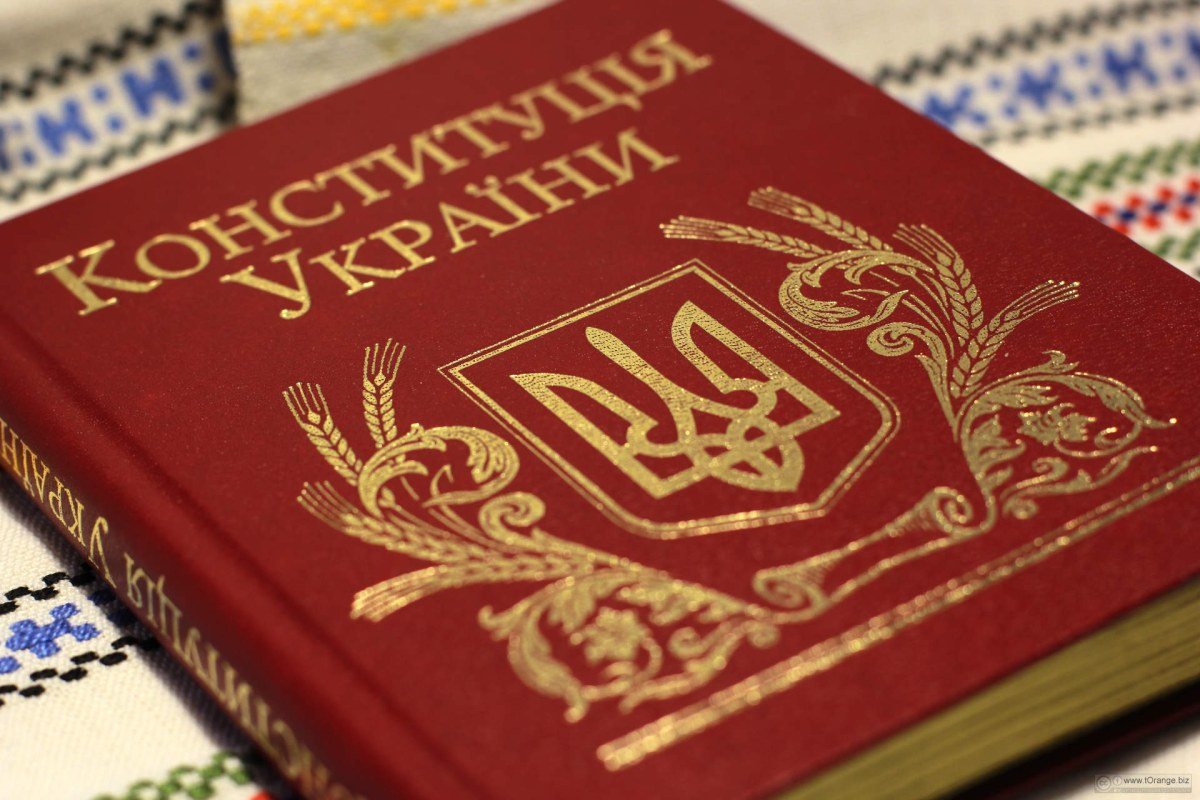
A constitution has to strike a delicate balance. It must be firm enough to protect fundamental rules from the passing interests of any government, yet flexible enough to adapt as a society develops. The Constitution of Ukraine achieves this balance through a demanding amendment procedure, set out in a dedicated chapter, and through a set of firm limits on what may never be changed at all. Since 1996 these rules have been tested several times, producing some of the most important turning points in Ukraine's political history.
Who can propose a change
Not everyone can initiate a constitutional amendment. The right belongs to the President of Ukraine and to a qualified group of people's deputies. The size of that group depends on which part of the Constitution is affected. For most chapters, a draft may be submitted by at least one-third of the constitutional composition of parliament, which means at least 150 of the 450 deputies. For the most fundamental chapters, the threshold rises to two-thirds of deputies.
Before parliament can consider any draft, it must obtain an opinion from the Constitutional Court. The Court checks whether the proposal complies with Articles 157 and 158 of the Constitution, which contain the key limits on amendments.
Two different procedures
The Constitution distinguishes between ordinary chapters and three especially protected ones: Chapter I (General Principles), Chapter III (Elections and Referendums) and Chapter XIII (Introducing Amendments to the Constitution). The procedures differ as follows:
- Ordinary chapters. A draft is first preliminarily approved by a simple majority of the constitutional composition, at least 226 votes. Then, at the next regular session, it must be finally adopted by at least two-thirds, or 300 votes. This two-step design forces deputies to return to the issue after a pause, reducing the risk of hasty decisions.
- Protected chapters. A draft must be adopted by at least two-thirds of deputies and then approved in an all-Ukrainian referendum called by the President. In this case the final word belongs directly to the people.
What can never be changed
Article 157 sets substantive limits. The Constitution may not be amended if the changes would abolish or restrict human and citizens' rights and freedoms, or if they are aimed at liquidating the independence of Ukraine or violating its territorial integrity. The same article forbids amendments during martial law or a state of emergency, when normal political life is disrupted.
Article 158 adds procedural safeguards. If a draft amendment is considered but not adopted, it may be resubmitted no sooner than one year later. In addition, during a single term of its powers, parliament may not amend the same provisions of the Constitution twice.
The main amendments since 1996
Despite these hurdles, the text has been revised several times. The most significant episodes include:
- The 2004 reform. Adopted in December 2004 and in force from 2006, these amendments shifted Ukraine from a presidential-parliamentary model towards a parliamentary-presidential one. The parliamentary majority, organised as a coalition of factions, gained a central role in forming the government, and the term of the Verkhovna Rada was extended from four to five years.
- The 2010 reversal. In 2010 the Constitutional Court found that the 2004 amendments had been adopted in breach of procedure, which effectively restored the original 1996 text and the stronger presidential model.
- The 2014 restoration. In February 2014 the Verkhovna Rada voted to return to the 2004 version of the Constitution, re-establishing the parliamentary-presidential balance that remains the basis of the system.
- The 2016 justice reform. A major package rewrote the provisions on the judiciary, reorganising the court system, creating the High Council of Justice in its current form, introducing the constitutional complaint and changing the role of the prosecutor's office.
- Removal of parliamentary immunity. An amendment adopted in 2019, effective from 2020, ended the broad immunity from criminal prosecution that people's deputies had previously enjoyed.
Why the process matters
The history of amendments shows how closely constitutional design is tied to the balance of power between the President, parliament and government. Because a change to the Constitution can redistribute that power, the procedure intentionally requires a broad consensus across political forces, a legal check by the Constitutional Court and, for the most fundamental questions, the direct consent of citizens.
For observers, the key lesson is that the Constitution of Ukraine is neither frozen nor easily rewritten. It evolves, but only through a deliberately slow and demanding process designed to protect the core principles adopted in 1996: the sovereignty of the people, the separation of powers and the priority of human rights.
What's Your Reaction?
 Like
0
 Dislike
0
 Love
0
 Funny
0
 Wow
0
 Sad
0
 Angry
0











Comments (0)